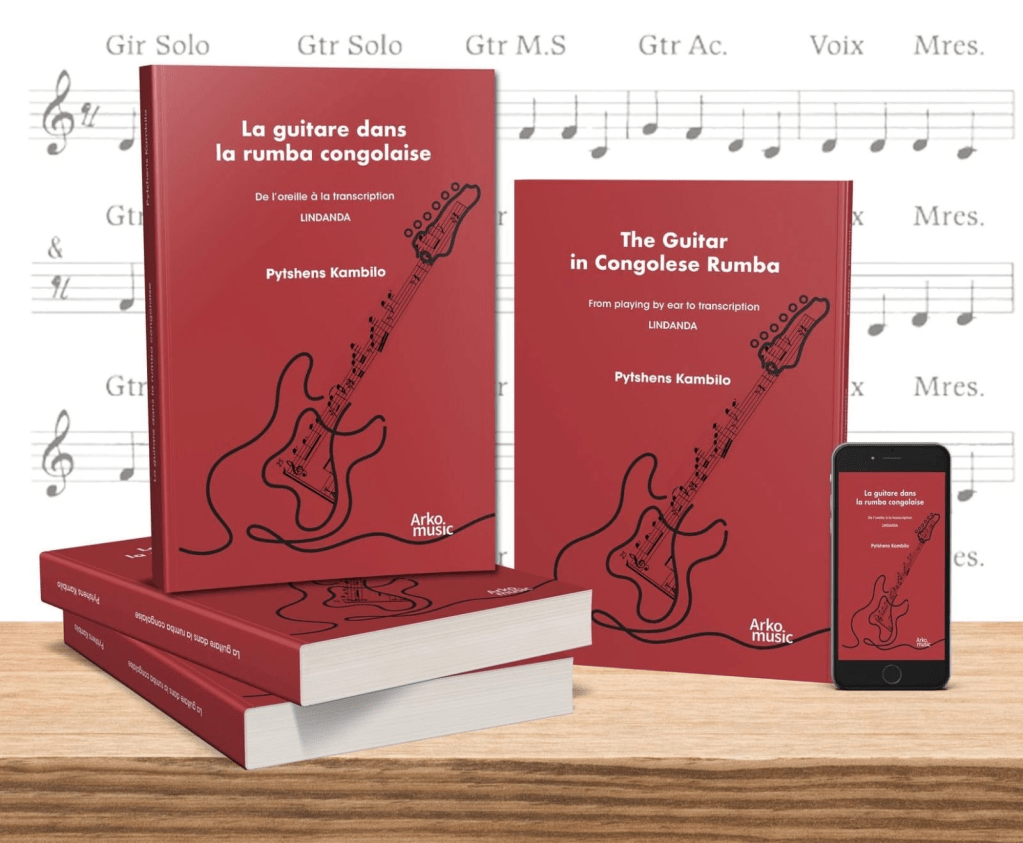
[EN] After five years of work devoted to analyzing the music, writing, and meeting with the legendary names of Congolese rumba, Pytshens Kambilo announces the publication of his book: ‘The Guitar in Congolese Rumba, from playing to ear, to transcription’. This promising book from the Kinshasa-born musician & songwriter comes in A4 format (270 pages) with archive photos, biographies of Congolese guitarists, their histories and 150 pages of sheet music. In short, essential work in preserving Congolese rumba! Pytshens delivered copies of the first and limited run (the English but also the French version) and you can order a copy by sending me a mail. Combining with Planet Ilunga releases is possible. Price is 40€.
[FR] Après cinq années de travail consacrées à l’analyse de la musique, de l’écriture et à la rencontre des grands noms légendaires de la rumba congolaise, Pytshens Kambilo annonce la parution de son livre : « La guitare dans la rumba congolaise: De l’oreille à la transcription. Lindanda.». Cet ouvrage du musicien et auteur-compositeur originaire de Kinshasa se présente au format A4 (270 pages) et comprend des photos d’archives, des biographies de guitaristes congolais, leurs parcours ainsi que 150 pages de partitions. En somme, une œuvre importante à la préservation de la rumba congolaise ! Pytshens a livré les premiers exemplaires de cette édition (en version anglaise et française), et vous pouvez en commander un en m’envoyant un mail. Il est également possible de combiner votre commande avec les parutions de Planet Ilunga. Prix : 40 €.
[FR, SUITE] La rumba congolaise est un élément central dans le patrimoine culturel congolais, et plus
généralement dans l’histoire du Kongo 1 , un genre majeur de la musique africaine, inscrit sur la
liste représentative du patrimoine culturel immatériel de l’humanité de l’Unesco en 2021.
Pour autant, cette musique n’a pas véritablement été codifiée. A quelques exceptions près, il
n’existe pas de partitions, tout se fait à l’oreille, par la transmission orale et la pratique. Même si
ce mode de transmission fonctionne dans le milieu musical congolais, disposer de partitions
apparaît indispensable pour faciliter la collaboration avec des musiciens et artistes issus de
traditions musicales différentes, assurer la transmission dans les écoles et la conservation ou
encore transmettre la culture congolaise à ses enfants nés en dehors du Kongo qui ont acquis
d’autres méthodes de fonctionnement.
Pytshens Kambilo a voulu combler ce manque, un peu sur les traces de l’écrivain et ethnologue
pionnier Hamadou Hampâté Bâ qui a pris le parti de mettre l’oralité à l’écrit car, selon lui, «
quand un vieillard meurt, c’est une bibliothèque qui brûle ». Il a entrepris pour cela un travail
pionnier d’archéologue musical qui s’est concrétisé avec le livre « La guitare dans la rumba
congolaise – de l’oreille à la transcription ».
Au-delà de ce travail de retranscription en partitions, il a effectué des recherches pour remettre
la rumba congolaise dans un contexte historique d’où une analyse de l’histoire de la rumba et de
ses liens avec l’histoire du Kongo et celles des mouvements de population induits notamment
par la traite transatlantique et la colonisation. Et pour pour comprendre les tréfonds de l’histoire
musicale traditionnelle du Congo et mettre en lumière ses apports à la musique moderne, un travail de laboratoire a également été réalisé pour analyser des centaines d’archives sonores.
L’ouvrage « La guitare dans la rumba congolaise – de l’oreille à la transcription » partage ainsi les partitions retranscrivant le jeu des guitares dans nombre des morceaux culte de la rumba congolaise afin de garder une trace de ce répertoire et de faciliter sa diffusion et son apprentissage. Il couvre globalement une période allant du début des années 40 à la fin des années 80. Quinze guitaristes sont représentés au travers d’une quarantaine de partitions ; parmi eux, des artistes à la genèse de l’histoire de la rumba congolaise à Kinshasa, Dr Nico Kasanda et Franco Luambo Makiadi, ou en province avec Jean Bosco Mwenda, mais également la génération Zaïko avec des artistes tels que Pépé Felly (Felix Manuaku Waku), Roxy Tshimpaka ou Beniko Popolipo.
Outre des partitions, cet ouvrage offre des biographies avec des photographies de pionniers de
la rumba congolaise, une mise en lumière des apports de la musique traditionnelle à la musique
moderne agrémentée de photographies d’instruments traditionnels et l’histoire de la rumba
intrinsèquement liée à l’histoire du Kongo.
[EN] Congolese rumba is a central element in Congolese cultural heritage, and more generally in the history of Kongo, major genre of African music, inscribed on the UNESCO Representative List of the Intangible Cultural Heritage of Humanity in 2021.
However, this music has not truly been codified. With a few exceptions, there are no musical scores, everything is learned by ear, through oral transmission and practice. Even if this method of transmission works within the Congolese musical community, having musical scores seems essential to facilitate collaboration with musicians and artists from different musical traditions, to ensure transmission in schools and preservation, and to pass on Congolese culture to children born outside the Kongo who have acquired other ways of functioning.
Pytshens Kambilo sought to fill this gap, somewhat following in the footsteps of the pioneering writer and ethnologist Hamadou Hampâté Bâ who made up his mind to commit oral tradition to writing because, according to him, “when an old man dies, a library burns down”. To this end, he undertook pioneering work as a musical archaeologist which materialize in the book “The Guitar in Congolese Rumba – From playing by ear to transcription”.
For several years, he carried out a scientific work to create this repertoire, meeting guitarists, analyzing their technique,… and performing the complex work of listening to and transcribing guitar playing into scores, an undertaking made all the more arduous by the fact that one of the particularities of rumba is the complementarity, or rather the superimposition, of sounds coming from two to four guitars on the same track, which implies a dissection to accurately extract the phrases played by each guitarist.

Beyond transcribing the music into musical scores, he conducted research to place Congolese rumba within a historical context. This involved analyzing the history of rumba and its connections to the history of the Kongo region and the population movements brought about by the transatlantic slave trade and colonization. Furthermore, to understand the depths of Congo’s traditional musical history and highlight its contributions to modern music, he also undertook laboratory work to analyze hundreds of sound archives.
The book ‘The Guitar in Congolese Rumba – From playing by ear to transcription’ shares scores transcribing guitar parts in many iconic Congolese rumba songs in order to preserve this repertoire and facilitate its dissemination and learning. It globally covers a period from the early 1940s to the late 1980s. Fifteen guitarists are represented through about forty scores; among them are artists at the genesis of Congolese rumba in Kinshasa, such as Dr. Nico Kasanda and Franco Luambo Makiadi, or in the provinces like Jean Bosco Mwenda, as well as the Zaïko generation with artists such as Pépé Felly (Felix Manuaku Waku), Roxy Tshimpaka or Beniko Popolipo.
In addition to music sheet, this book offers biographies with photographs of pioneers of Congolese rumba, an overview of the contributions of traditional music to modern music enhanced with photographs of traditional instruments and the history of rumba intrinsically linked to the history of the Kongo.


 Planet Ilunga