Pytshens Kambilo: The Guitar in Congolese Rumba /  La guitare dans la rumba congolaise: De l’oreille à la transcription.

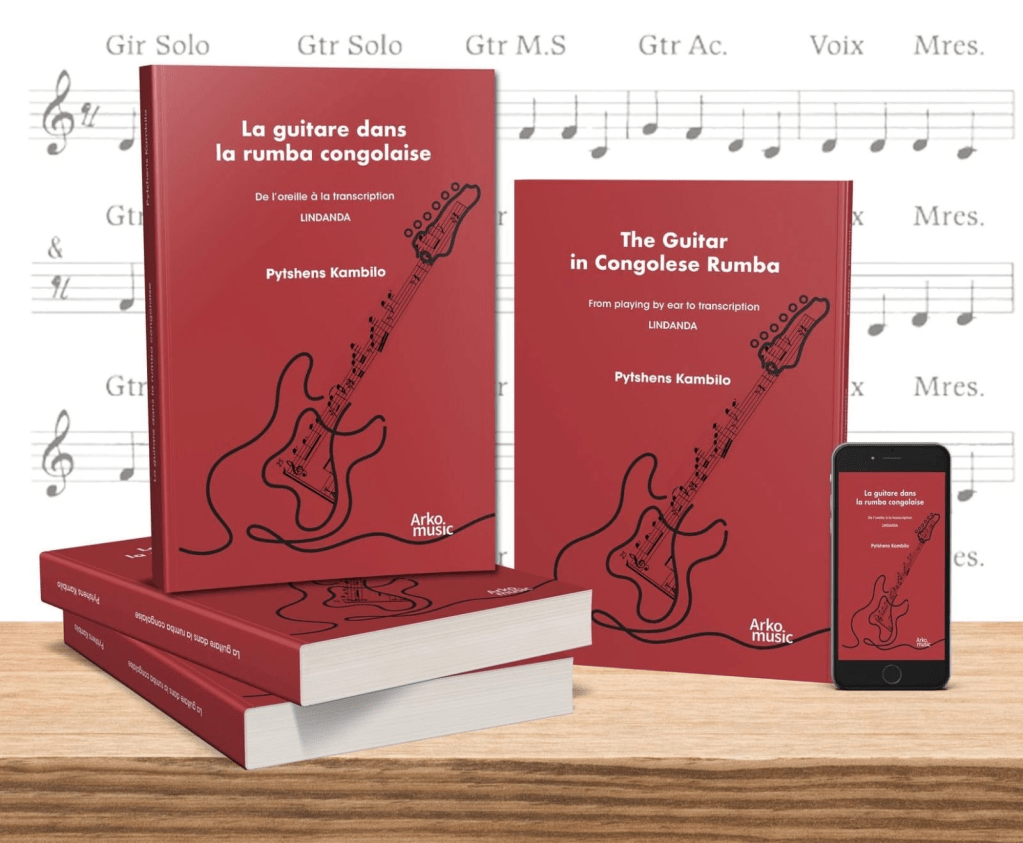
[EN] After five years of work devoted to analyzing the music, writing, and meeting with the legendary names of Congolese rumba, Pytshens Kambilo announces the publication of his book: ‘The Guitar in Congolese Rumbafrom playing to ear, to transcription’. This promising book from the Kinshasa-born musician & songwriter comes in A4 format (270 pages) with archive photos, biographies of Congolese guitarists, their histories and 150 pages of sheet music. In short, essential work in preserving Congolese rumba! Pytshens delivered copies of the first and limited run (the English but also the French version) and you can order a copy by sending me a mail. Combining with Planet Ilunga releases is possible. Price is 40€. 

[FR] Après cinq années de travail consacrées à l’analyse de la musique, de l’écriture et à la rencontre des grands noms légendaires de la rumba congolaise, Pytshens Kambilo annonce la parution de son livre : « La guitare dans la rumba congolaise: De l’oreille à la transcription. Lindanda.». Cet ouvrage du musicien et auteur-compositeur originaire de Kinshasa se présente au format A4 (270 pages) et comprend des photos d’archives, des biographies de guitaristes congolais, leurs parcours ainsi que 150 pages de partitions. En somme, une œuvre importante à la préservation de la rumba congolaise ! Pytshens a livré les premiers exemplaires de cette édition (en version anglaise et française), et vous pouvez en commander un en m’envoyant un mail. Il est également possible de combiner votre commande avec les parutions de Planet Ilunga. Prix : 40 €.

[FR, SUITE] La rumba congolaise est un élément central dans le patrimoine culturel congolais, et plus
généralement dans l’histoire du Kongo 1 , un genre majeur de la musique africaine, inscrit sur la
liste représentative du patrimoine culturel immatériel de l’humanité de l’Unesco en 2021.

Pour autant, cette musique n’a pas véritablement été codifiée. A quelques exceptions près, il
n’existe pas de partitions, tout se fait à l’oreille, par la transmission orale et la pratique. Même si
ce mode de transmission fonctionne dans le milieu musical congolais, disposer de partitions
apparaît indispensable pour faciliter la collaboration avec des musiciens et artistes issus de
traditions musicales différentes, assurer la transmission dans les écoles et la conservation ou
encore transmettre la culture congolaise à ses enfants nés en dehors du Kongo qui ont acquis
d’autres méthodes de fonctionnement.

Pytshens Kambilo a voulu combler ce manque, un peu sur les traces de l’écrivain et ethnologue
pionnier Hamadou Hampâté Bâ qui a pris le parti de mettre l’oralité à l’écrit car, selon lui, «
quand un vieillard meurt, c’est une bibliothèque qui brûle ». Il a entrepris pour cela un travail
pionnier d’archéologue musical qui s’est concrétisé avec le livre « La guitare dans la rumba
congolaise – de l’oreille à la transcription ».

Au-delà de ce travail de retranscription en partitions, il a effectué des recherches pour remettre
la rumba congolaise dans un contexte historique d’où une analyse de l’histoire de la rumba et de
ses liens avec l’histoire du Kongo et celles des mouvements de population induits notamment
par la traite transatlantique et la colonisation. Et pour pour comprendre les tréfonds de l’histoire
musicale traditionnelle du Congo et mettre en lumière ses apports à la musique moderne, un travail de laboratoire a également été réalisé pour analyser des centaines d’archives sonores.

L’ouvrage « La guitare dans la rumba congolaise – de l’oreille à la transcription » partage ainsi les partitions retranscrivant le jeu des guitares dans nombre des morceaux culte de la rumba congolaise afin de garder une trace de ce répertoire et de faciliter sa diffusion et son apprentissage. Il couvre globalement une période allant du début des années 40 à la fin des années 80. Quinze guitaristes sont représentés au travers d’une quarantaine de partitions ; parmi eux, des artistes à la genèse de l’histoire de la rumba congolaise à Kinshasa, Dr Nico Kasanda et Franco Luambo Makiadi, ou en province avec Jean Bosco Mwenda, mais également la génération Zaïko avec des artistes tels que Pépé Felly (Felix Manuaku Waku), Roxy Tshimpaka ou Beniko Popolipo.

Outre des partitions, cet ouvrage offre des biographies avec des photographies de pionniers de
la rumba congolaise, une mise en lumière des apports de la musique traditionnelle à la musique
moderne agrémentée de photographies d’instruments traditionnels et l’histoire de la rumba
intrinsèquement liée à l’histoire du Kongo.

[EN] Congolese rumba is a central element in Congolese cultural heritage, and more generally in the history of Kongo, major genre of African music, inscribed on the UNESCO Representative List of the Intangible Cultural Heritage of Humanity in 2021.

However, this music has not truly been codified. With a few exceptions, there are no musical scores, everything is learned by ear, through oral transmission and practice. Even if this method of transmission works within the Congolese musical community, having musical scores seems essential to facilitate collaboration with musicians and artists from different musical traditions, to ensure transmission in schools and preservation, and to pass on Congolese culture to children born outside the Kongo who have acquired other ways of functioning.


Pytshens Kambilo sought to fill this gap, somewhat following in the footsteps of the pioneering writer and ethnologist Hamadou Hampâté Bâ who made up his mind to commit oral tradition to writing because, according to him, “when an old man dies, a library burns down”. To this end, he undertook pioneering work as a musical archaeologist which materialize in the book “The Guitar in Congolese Rumba – From playing by ear to transcription”. 

For several years, he carried out a scientific work to create this repertoire, meeting guitarists, analyzing their technique,… and performing the complex work of listening to and transcribing guitar playing into scores, an undertaking made all the more arduous by the fact that one of the particularities of rumba is the complementarity, or rather the superimposition, of sounds coming from two to four guitars on the same track, which implies a dissection to accurately extract the phrases played by each guitarist.

Beyond transcribing the music into musical scores, he conducted research to place Congolese rumba within a historical context. This involved analyzing the history of rumba and its connections to the history of the Kongo region and the population movements brought about by the transatlantic slave trade and colonization. Furthermore, to understand the depths of Congo’s traditional musical history and highlight its contributions to modern music, he also undertook laboratory work to analyze hundreds of sound archives.

The book ‘The Guitar in Congolese Rumba – From playing by ear to transcription’ shares scores transcribing guitar parts in many iconic Congolese rumba songs in order to preserve this repertoire and facilitate its dissemination and learning. It globally covers a period from the early 1940s to the late 1980s. Fifteen guitarists are represented through about forty scores; among them are artists at the genesis of Congolese rumba in Kinshasa, such as Dr. Nico Kasanda and Franco Luambo Makiadi, or in the provinces like Jean Bosco Mwenda, as well as the Zaïko generation with artists such as Pépé Felly (Felix Manuaku Waku), Roxy Tshimpaka or Beniko Popolipo.

In addition to music sheet, this book offers biographies with photographs of pioneers of Congolese rumba, an overview of the contributions of traditional music to modern music enhanced with photographs of traditional instruments and the history of rumba intrinsically linked to the history of the Kongo.

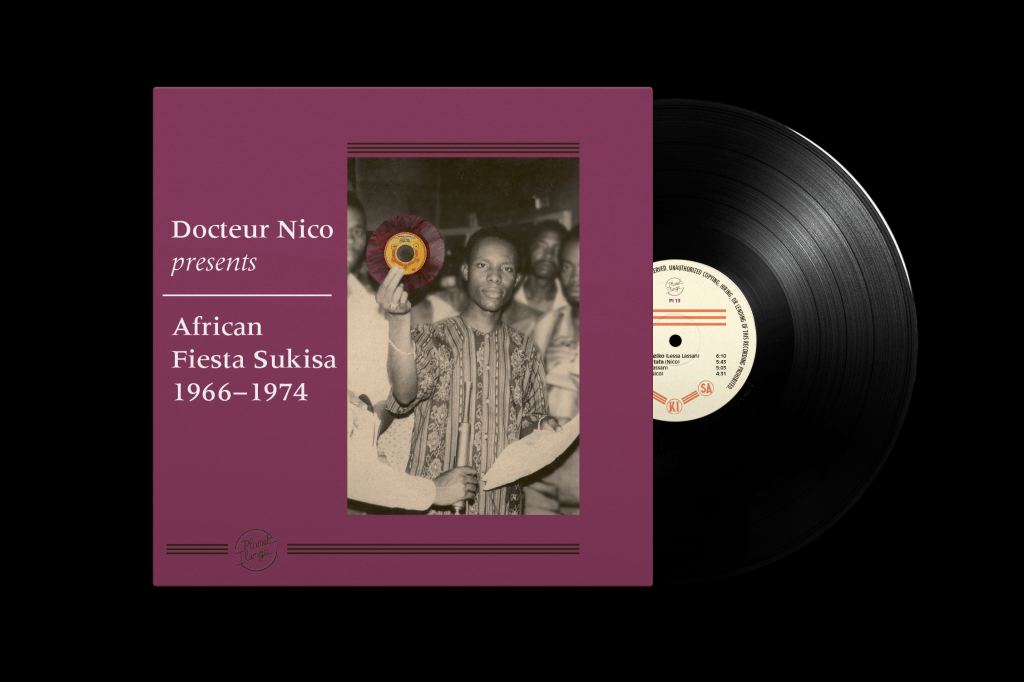
New Release: Docteur Nico Presents African Fiesta Sukisa 1966-1974

Planet Ilunga presents Docteur Nico & African Fiesta Sukisa (1966-1974)
(3LP & Digital)

** RELEASE DATE: December 5 **


Planet Ilunga presents, in collaboration with the children of Nico Kasanda alias Docteur Nico, an anthology dedicated to African Fiesta Sukisa, available as a 3LP and a digital release (with bonus songs). This release is the fruit of many years of preparations and was realized in close partnership with Liliane Kasanda, Nico’s eldest daughter. Marking forty years since his passing, we felt that the year 2025 was the right time to honor Docteur Nico’s legacy with this original collection.

Almost all of the African Fiesta Sukisa songs were released on Nico’s Sukisa label which translates in Lingala for “the final accomplishment”. The music on Sukisa, crafted by Nico, Dechaud and legendary vocalists such as Chantal, Sangana, Apôtre, Lessa Lassan and Josky, embodies the essence of that powerful phrase with genius and class. The label ran between 1966 and 1975 and released approximately 280 songs. Ngoma also issued the group between 1967 and 1971 and, in addition, reissued material from the Sukisa label. Many of the Sukisa songs have become part of the collective memory of Congolese society and are still heard, discussed, and analyzed daily across digital platforms worldwide, as well as on numerous Congolese radio and television stations.

The album we put together features some of African Fiesta Sukisa’s signature songs alongside never before reissued tracks from the Sukisa catalog. It furthermore contains a large booklet with song commentary, testimonial interviews from well-known musicians, journalists, fans and Nico’s entourage, besides never-before-published photos from the family’s personal archive, illustrating the life and career of the one and only ‘dieu de la guitare’.

Alastair Johnston, author of the book ‘A Discography of Docteur Nico’ and longstanding Planet Ilunga collaborator, designed a stylish booklet and cover using all our collected material. Audifax Bemba, longtime admirer, compiler and connoisseur of Nico’s music, and the author of most of the song commentary in our accompanying and very visual booklet, offers his portrait of Nico Kasanda:

“After displaying technical virtuosity with African Jazz, expert and accomplished guitar with African Fiesta, which musicologist Sylvain Bemba described as a dream guitar, Nico Kasanda was consecrated ‘dieu de la guitare’ by the public in the late sixties. With his band African Fiesta Sukisa, Docteur Nico displays his wide palette of unusual sounds. While exploring the Hawaiian guitar with its clear, airy, plangent, psychedelic effluvia, he continues to replicate the piano comping technique, and adds two missing strings to his bow: a simulation of the sanza (likembé or thumb piano), whose sounds he reproduces right down to the noisemakers of the tiny tin rings on the one hand, and the sounds of the Luba balafon on the other.


The right note, in the right place, at the right time, is the triptych on which Nico Kasanda’s playing is based, a note dressed in the perfect sound. A guitar of pure emotion. With African Fiesta Sukisa, his playing takes a ‘Chopin-esque’ turn, sending out more notes in a sublime adagio. The true artist is the one who simplifies everything. Docteur Nico is a genius of our time, whose style makes him the supreme exponent of the most important guitar school in Congolese music. He is recognized by his peers as the greatest African solo guitarist of all time. Sculpting sound in a tireless quest for beauty, Nico Kasanda has sublimated the guitar throughout his career.”


Release info

* 3LP album with a large 28-page booklet: tracklist
* digital album with bonus tracks (coming soon on Bandcamp)
* liner notes in English & French 
* made in collaboration with the estate of Nicolas Kasanda
* numbered LP edition
* manufactured by Pallas (Germany)
* worldwide distribution

Acknowledgements

Concept & compilation: Bart Cattaert
Notes: Audifax Bemba, Alastair Johnston, Bart Cattaert
Art Direction: Alastair Johnston
Proofing: Hayat Assabounti & Alastair Johnston
Audio restoration & mastering: Pieter De Wagter (EQuuS)
Lacquer cut: Michael Kuhn (Manmade Mastering)
Video editor: Alan Brain
Manufacturer: Pallas in coordination with Britta Fanck (Handle With Care)

My gratitude to: Liliane, Francois, Georges, Annie & Nicole Kasanda, Audifax Bemba, Alastair Johnston, Sam Mangwana, Alan Brain, Emmanuel Bossekota, Henry-Noel Mbuta Vokia, Bony Bikaye, Gary Stewart, Maika Munan, Pepe Felly Manuaku, Jean-Paul Vangu, Dizzy Mandjeku, Hayat Assabounti, Jean Paul Kitenge Muadi, Zoi Sakka, La Fondation Dr Nico, Pieter De Wagter, Mike Grinser, Paul Cavvadias, Arts-Loi, Christian Ongoba, Alexandre Bodiou, Frank Wouters, Cindy Teme, Robert Keith, Florent Mazzoleni, Xavier Jacono.

Special word of thanks goes to Liliane “Titi” Kasanda, who entrusted me with the precious task of honoring her father’s legacy through this anthology, showing patience and discretion. I am also grateful to Audifax Bemba for his passion and knowledge of Nico’s music and his humor, as well as to Alastair Johnston for his generous advice and additions to the tracklist and for the design of this album. And finally to all the friends of Nico in the Democratic Republic of the Congo and around the world who have shared a testimonial.

© 2025 Planet Ilunga
planetilunga@gmail.com

New release: Franco Luambo Makiadi Presents Les Editions Populaires

Pour nos lecteurs francophones: Cliquez ici pour la version française de cet article

After the anniversary edition about the illustrious Ngoma label, Planet Ilunga moves forward in time with its upcoming release. With the new series ‘Les éditeurs congolais’ Planet Ilunga aims to honour and highlight the phonographic and entrepreneurial work of the first Congolese record label bosses. We kick off with a compilation of one of the most significant labels, Les Editions Populaires, founded by Franco Luambo Makiadi.

‘Indépendance Cha Cha’ was an historic song, not only because it immortalized Congo’s independence in its lyrics, but also because it was the first single published by a Congolese-owned record label. Joseph Kabasele’s label Surboum African Jazz indeed paved the way for several Congolese musicians to become record publishers. It resulted in the 1960s in a plethora of newly found Kinshasa-based record labels, run by the biggest musicians of the time.

Les Editions Populaires was founded by Franco in 1968 after he first co-founded with Vicky Longomba the labels Epanza Makita (+/- 117 singles) and Boma Bango (+/- 50 singles) and after starting his first short-lived label Likembe (+/- 5 singles). It ran until 1982 and was mostly dedicated to the output of OK Jazz (later TPOK Jazz).

This compilation brings together an original selection of 16 tracks from the first three years of Les Editions Populaires. They are a showcase of the sound Franco had envisioned for his band. The focus was less on cha-cha-cha and Spanish lyrics, but on lingering rumba and bolero ballads in Lingala, tradition-rooted songs in Kikongo, Kimongo and even Yoruba, collaborations with Ngoma artists Camille Feruzi and Manuel d’Oliveira and not to forget solid pastiches of American funk, which were showing that the OK Jazz musicians had an open-minded view on music and were capable of excelling in many genres.

  • 2LP album in a trifold edition: tracklist
  • liner notes in English & French
  • made in collaboration with the estate of Franco Luambo Makiadi
  • design: Murielle Lô
  • studio engineers: Pieter De Wagter (remastering) & Michael Kuhn (lacquer cut)
  • numbered LP edition

Acknowledgements

General editor, notes & concept: Bart Cattaert
Compiled by: Hama-Dinga Ya Makilo, Stefan Werdekker & Bart Cattaert
Art Direction: Murielle Lô
Proofing: Charlotte Mavandalt, Hayat Assabounti & Alastair Johnston
Audio restoration & mastering: Pieter De Wagter (EQuuS)
Lacquer cut: Michael Kuhn (Manmade Mastering)
Manufacturer: Optimal Media in coordination with Britta Fanck (Handle With Care)

My gratitude to: Yves Luambo Emongo, Stefan Werdekker, Hama-Dinga Ya Makilo, Sylvain Konko, Murielle Lô, Clémence de Bodinat, Gary Stewart, Christian Ongoba, Baudouin Bikoko, Cindy Teme, Charlotte Mavandalt, Alastair Johnston, Hayat Assabounti, Samuel Malonga, Aaron Minnebo & Edo Bouman

Authorized by the estate of Franco Luambo Makiadi
Copyright © 2024 Planet Ilunga

** Pre-orders through our website, email or Bandcamp. Release date is Thursday 29th of February (start shipping on 21st of February) **